
Recruiter guide / industry insight17 Apr 2026
The roles recruiters secretly love working on
A light, insider look at the kinds of roles recruiters genuinely enjoy working on, and why those searches usually attract better candidates and move faster.
Recruiter economics and fees
UK employers are rethinking recruitment agency fees in 2026 as hiring slows, costs rise and traditional fee models face more scrutiny. Here is what has changed and what to review.

A year or two ago, many employers could still justify paying a standard agency fee on the basis that the market was hard, candidate supply was tight and speed mattered more than precision. That logic is weaker in 2026.
The UK hiring market is not frozen, but it is clearly more selective. CIPD’s Winter 2025/26 Labour Market Outlook says hiring intentions remain at historically low levels outside the pandemic, hard-to-fill vacancies are relatively limited, and most employers expect the Employment Rights Act to push up employment costs. KPMG and REC’s March 2026 Report on Jobs adds a similar texture: permanent placements were still falling in February, vacancies were still declining, but candidate availability had risen sharply. In plain terms, many employers are operating in a market where hiring is harder to get approved, easier to slow down, and less forgiving of wasted spend.
That changes how recruitment agency fees are judged. The old question was often, “What percentage are you charging?” The more useful 2026 question is, “What exactly are we buying, and does the model improve the odds of a good hire without creating cost elsewhere?”
The background matters. ONS reported that UK vacancies in December 2025 to February 2026 were down 9.5% year on year, with declines across 15 of 18 sectors. CIPD’s net employment balance sat at +7, which it described as low by historical standards outside the pandemic. This is not a market where most employers are scaling hiring aggressively. It is a market where approval chains are tighter, role design is more debated, and external spend needs a stronger business case.
On top of that, employers are weighing broader labour costs. CIPD found that 74% of employers expected the Employment Rights Act to increase costs, and around 40% expected to hire fewer permanent workers as a result of key reforms. The government’s own economic analysis takes a more positive long-term view overall, but it also acknowledges risks: stronger protections can affect hiring behaviour if businesses feel they cannot absorb higher labour costs, and some employers may respond by cutting other spending or shifting toward more casual forms of labour.
That matters for agency fees because recruitment spend does not sit in isolation. It is now being judged alongside payroll taxes, compliance, salary inflation, management time and the risk of adding permanent headcount too quickly.
This is the first big shift. In tighter markets, companies stop looking at agency fees as a standalone procurement line and start looking at them as part of the full cost of a hire.
A 20% contingent fee can still be perfectly rational. For a niche role, a confidential search, or a business with no internal sourcing capability, paying a specialist recruiter can save weeks of drift and a lot of management time. The problem is that many fee discussions still happen as if all agency delivery models are roughly the same. They are not.
Industry guidance aimed at UK employers still commonly describes permanent recruitment fees as a percentage of first-year salary, often in roughly the 15% to 30% range depending on role type and search model. That structure is familiar, but familiarity is not the same as fit. In a more selective market, employers are asking a sharper question: does a percentage-of-salary fee reflect the actual work, focus and accountability involved in this search?
That question becomes even sharper when the hiring process itself is slow. A company can pay a full success fee for a hire, but still carry hidden costs from rebriefing, duplicated outreach, weak calibration, inconsistent candidate assessment and time lost across hiring managers. In other words, the invoice may be one cost, but the operating friction around the hire can be much larger.
This is where 2026 is forcing a rethink. Contingency recruitment has obvious strengths. It lowers upfront risk for the employer, can work well on repeatable roles, and gives access to recruiter networks without a retained commitment. Used well, it can still be efficient.
But the model also has structural weaknesses, especially when several agencies are competing on the same brief. The recruiter bears the delivery risk, so the natural incentive is to move fast, widen the funnel, and prioritise roles most likely to convert. That can create exactly the behaviours employers say they do not want: shallow briefing, repeated candidate overlap, rushed outreach and more emphasis on speed than on role design or evidence of fit.
In a hot market, employers often tolerated those flaws because scarcity made speed paramount. In a softer market with more candidate supply, those flaws stand out more clearly. KPMG and REC reported a further sharp rise in candidate numbers in February 2026, while vacancies continued to fall. When supply improves but employers are still not seeing better outcomes, the conversation naturally moves from “We need more CVs” to “Why are we paying this fee for this process?”
That does not mean contingency is finished. It means employers are less willing to treat a generic, multi-agency, percentage-based model as the default setting for every hire.
The opposite mistake is to assume retained search is automatically the smarter answer. It is not.
Retained models make the most sense when the search genuinely needs depth: senior leadership hires, hard-to-access talent pools, high-confidentiality projects, or roles where market mapping and careful assessment matter more than speed alone. In those cases, a structured retained process can produce better alignment because the recruiter is paid to work the brief properly, not just to win a race.
But retained search can also become a comfort blanket. Some employers pay for a depth of process they do not really need. Others use it because their internal hiring process is weak, hoping the external partner will compensate for unclear scorecards, indecisive stakeholders or inconsistent interview discipline. That usually leads to disappointment whichever fee model is used.
The better way to think about retained versus contingent in 2026 is not prestige versus price. It is alignment versus mismatch. The right model is the one that matches the complexity of the role, the maturity of the employer’s process and the level of market work actually required.
This is the deeper structural shift underneath the fee debate.
For years, a large part of agency value came from access: access to candidate networks, access to passive talent, access to recruiter relationships and access to search capability that many companies did not have internally. That still matters, but it matters differently now. Candidate sourcing tools are more accessible. Employer brands are more visible. Internal talent teams are often stronger than they were a decade ago. And in some sectors, candidate availability has improved.
So the value of a recruiter increasingly sits elsewhere. Not just in finding people, but in narrowing signal. In qualifying motivation. In pressure-testing a brief. In telling a client their process is causing drop-off. In helping both sides make decisions with less noise.
That is why percentage fees feel more exposed in 2026. If the work is mostly access, employers may feel they can replicate more of it themselves. If the work is judgement, calibration and disciplined search, the fee is easier to defend.
There is also an uncomfortable industry truth here. Some fee structures are trying to fund inefficient operating models.
Traditional agencies often carry layers of overhead: office costs, management layers, sales targets, delivery splits, researcher costs, marketing costs and consultant commission structures that reward activity more than precision. None of that is automatically wrong. Agencies do provide real value, and good ones absorb risk, train recruiters well and build genuine market expertise.
But when the employer is being asked to pay a premium percentage fee, it is fair to ask whether the price reflects search quality or simply the cost of the intermediary structure. In a market where hiring volumes are softer, that question gets louder, because employers are less willing to subsidise inefficiency.
This is one reason alternative models keep gaining attention. Independent recruiters and more flexible recruiter networks can sometimes offer lower structural cost, more specialist delivery and clearer accountability because there are fewer layers between client, recruiter and outcome. That does not make them universally better, but it does make them increasingly relevant in a year when buyers want more transparency and more control.
This is the most useful way to rethink recruitment agency fees.
Every pricing model creates behaviour.
A pure contingent race tends to create urgency, selective effort and a bias toward quick conversion. A retained model tends to create more structure and depth, but can reduce pressure if the brief is not tightly managed. A lower-cost specialist or independent model may create stronger alignment, but only if the recruiter genuinely has the time and expertise to own the search.
So when employers review fees in 2026, they should look beyond the percentage and ask four practical questions:
Those questions get closer to value than a procurement-only discussion ever will.
2026 is pushing employers to rethink recruitment agency fees because the market no longer hides inefficiency as easily as it did before. Hiring is slower, approvals are tighter, vacancy demand is softer, and wider employment costs are rising. In that environment, companies are less willing to accept percentage-based recruitment fees as a default. They want the delivery model behind the fee to make operational sense.
That does not mean agency fees are unjustified. It means they need a stronger link to actual value. Agencies still earn their place where they bring specialism, access, judgement, pace and market credibility that the employer does not have internally. But employers are right to challenge fee structures that reward noise, duplicate effort or poor alignment.
The firms that will defend their fees best in 2026 are not necessarily the cheapest. They are the ones whose model is easiest to understand and hardest to waste. In practice, that often means more transparent scope, more focused ownership of the brief, fewer layers between client and recruiter, and clearer evidence of how the search is being run.
That is also why this conversation is bigger than procurement. It is about hiring design. Better hiring models reduce waste on both sides. They give employers more control and they let good recruiters spend time where they add value, not where the structure forces them to.
When reviewing recruitment agency fees in 2026, employers should do three things.
Start with the role, not the rate. A repeated, mid-level hire with clear market visibility does not need the same fee logic as a confidential leadership search.
Audit the hidden operating costs around agency use. If your team is still rebriefing, filtering duplicated candidates and chasing feedback, the fee is only part of the cost.
Ask the recruiter to explain the delivery model in plain language. Who owns the search, how many similar briefs are they running, what work is done before candidates are sent, and what part of the fee reflects actual specialist effort rather than generic process?
For recruiters, the lesson is equally clear. In 2026, defending fees with market clichés will not work for long. Employers want to understand how the model works, why it fits the brief, and what problem it solves better than the alternatives.
Recruitment agency fees are under more pressure in 2026 because hiring itself is under more pressure. The issue is not simply that employers want cheaper support. It is that they want support that matches the real economics of hiring now.
In a more cautious market, percentage-based fees stop feeling neutral. They become a statement about value, incentives and operating design. The agencies and recruiter models that thrive this year will be the ones that can show not just that they can fill roles, but that their way of working reduces waste, improves judgement and gives the employer a better grip on the process.
That is the real rethink happening now. Employers are not just renegotiating fees. They are re-evaluating what a recruitment partner should actually be.
If you are reviewing recruitment spend this year, it is worth looking beyond fee percentage alone and testing whether the model behind the fee is built for today’s market. That is often where the biggest savings, and the biggest quality gains, actually sit.
Written by Brendan Woodage
Precision curation journal
Recommended reading
A few nearby essays from the same archive, chosen from other published posts.
A light, insider look at the kinds of roles recruiters genuinely enjoy working on, and why those searches usually attract better candidates and move faster.
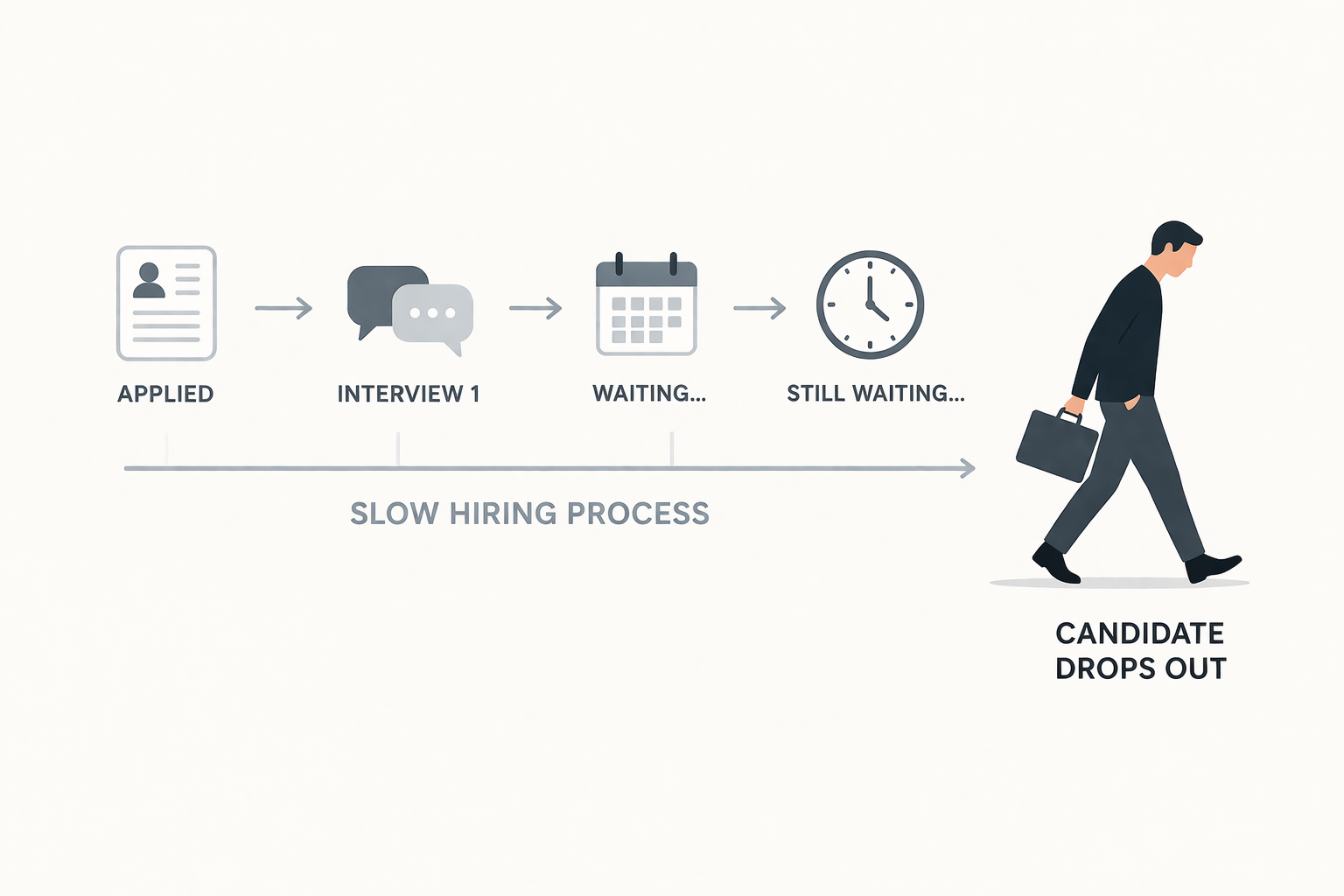
Slow hiring does more than delay a decision. It creates doubt, weakens candidate confidence and increases dropoff. Here’s why good candidates leave slow processes, and how to fix it.
Timetohire is one of the most tracked recruitment metrics. But when speed becomes the primary goal, hiring quality suffers. Here’s what the data says and what to measure instead.